Senators Reach Deal on Stablecoin Yield; Coinbase Backs Markup
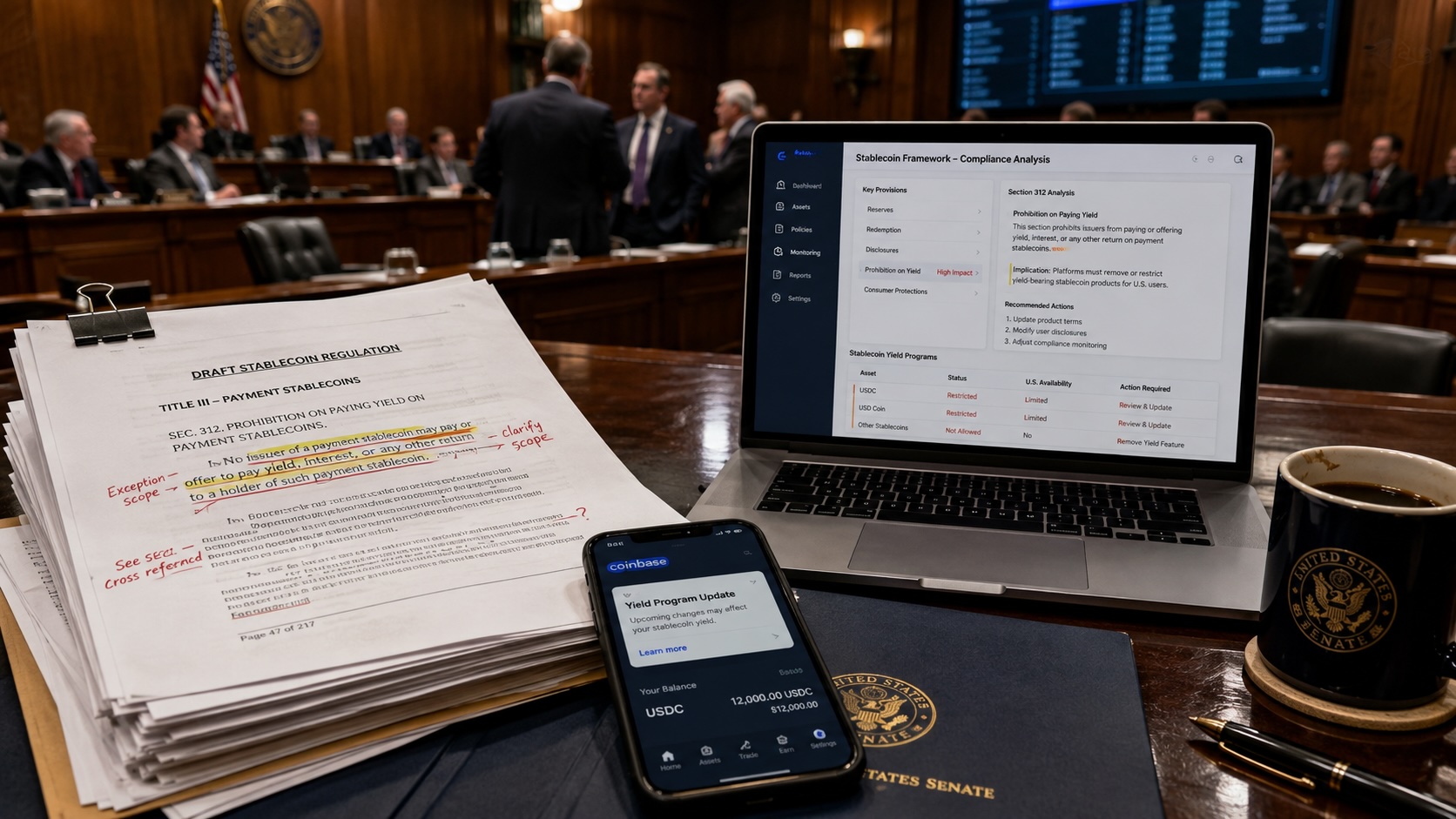
Senators agreed to bar stablecoin payments that mirror bank interest while allowing activity-based rewards; Coinbase CEO Brian Armstrong endorsed a Senate Banking Committee markup of the Clarity Act.
Senators reached an agreement to bar stablecoin payments that are “economically or functionally equivalent” to interest on bank deposits while allowing rewards tied to specific activities. Coinbase CEO Brian Armstrong posted “Mark it up,” signaling support for a Senate Banking Committee markup of the Clarity Act and raising expectations the bill could advance to a committee vote.
The draft language bars stablecoin issuers and other crypto firms from offering passive yield that mimics bank interest. It permits “rewards or incentives” tied to bona fide activities such as transactions, payments, transfers, remittances and providing liquidity to decentralized finance protocols. The bill would give U.S. financial regulators one year to issue rules defining when a reward crosses the line into a prohibited interest-like payment.
The draft aims to clarify treatment left unresolved by last year’s stablecoin law, known as the GENIUS Act, which banned issuers from paying yield on digital dollars. Lawmakers drafted the Clarity Act to address whether third-party platforms, including exchanges, can offer interest-like returns.
Armstrong previously withdrew support for the bill in January, prompting Senate Banking Committee Chair Tim Scott to postpone a scheduled markup while negotiators revised the language. After Armstrong’s post backing a markup, odds on a prediction market that the Clarity Act will pass in 2026 rose from 46% to 64%.
Reaction in the crypto sector was mixed. Investor Nic Carter wrote, “The banks won.” Attorney Scott Johnsson wrote, “This is fine. It may not feel like it, but it is.” The Blockchain Association’s CEO Summer Mersinger wrote that resolving the yield question “clears the path to a Senate Banking Committee markup and brings us meaningfully closer to comprehensive market structure legislation becoming law,” and urged lawmakers to move quickly.
Senate Banking Committee leadership indicated Republicans are moving toward consensus and are working toward a bipartisan markup, with plans discussed for a markup in May. If the Senate approves a version of the Clarity Act, its text will need to be reconciled with a bill the House passed nearly a year ago before any final legislation can reach the president.
The draft leaves practical questions unresolved. The one-year regulatory timeline means U.S. agencies will set definitions and rules that determine which incentive programs qualify as allowable activity-based rewards and which resemble prohibited yield products.
Tags
Articles by this author