Senate Banking Unveils 309-Page CLARITY Act Rewrite
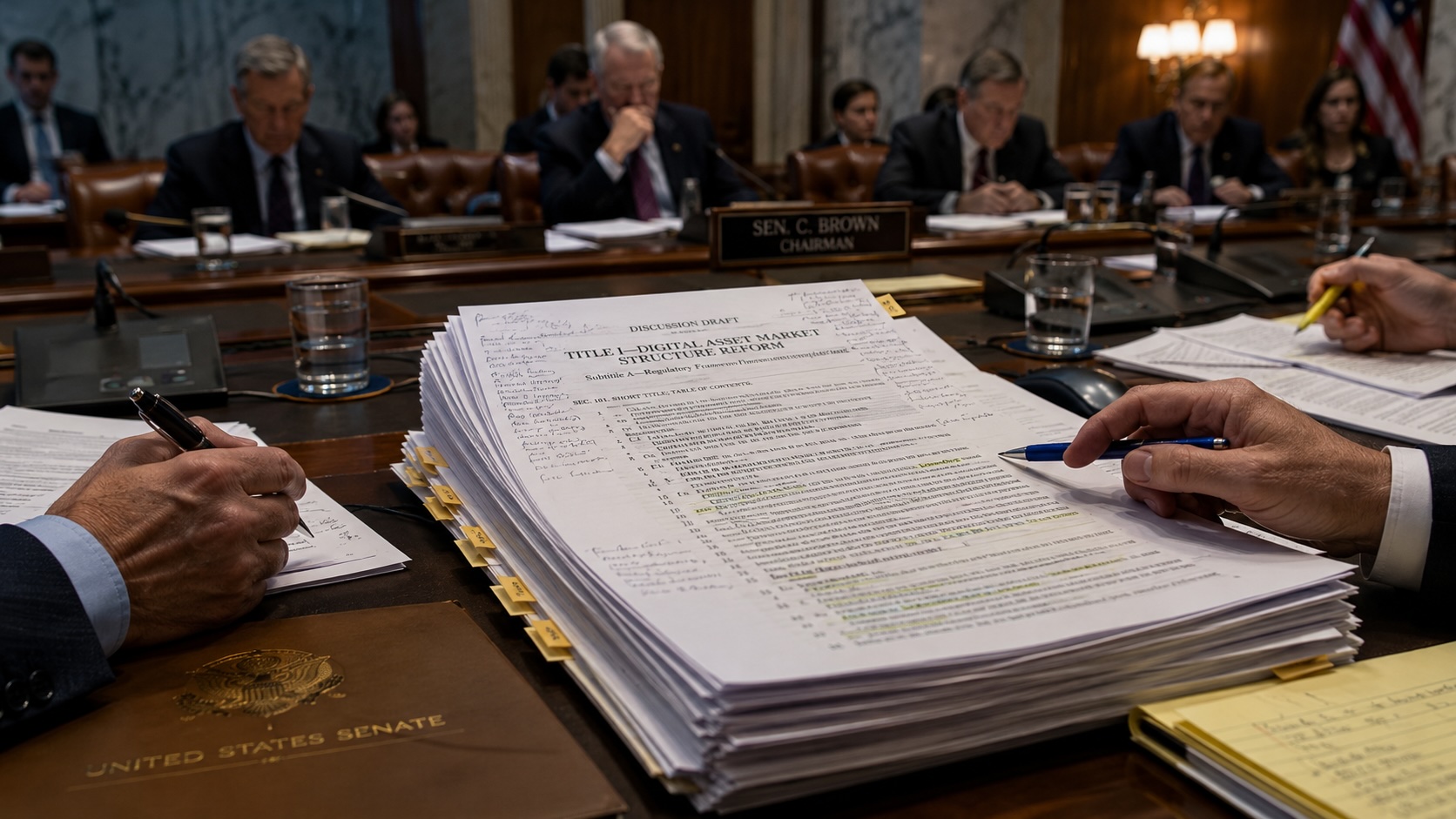
Senate Banking Committee released a 309-page CLARITY Act rewrite adding the Tillis‑Alsobrooks stablecoin compromise, an insolvency safe harbor and insider-trading rules ahead of Thursday’s markup.
The Senate Banking Committee released a 309-page rewrite of the Digital Asset Market CLARITY Act of 2025 ahead of a scheduled executive session and a Thursday markup. The text expands a January draft and was posted after committee members were given a short window to file amendments. Members have until the close of business tomorrow to submit amendments before a 10:30 a.m. ET executive session, and the committee plans to vote on the measure on Thursday.
The bill previously cleared the House in July 2025 with bipartisan support. Negotiations in the Senate stalled earlier this year largely over how to treat stablecoin yield. The May rewrite preserves the bill’s nine-title structure and adds 31 pages of new language and revisions to key sections.
Section 404 incorporates a bipartisan compromise from Senators Thom Tillis and Angela Alsobrooks that allows regulated stablecoin issuers to offer certain types of yield or rewards under tighter limits and enhanced oversight. The language aims to restrict stablecoins from operating like unregulated bank deposits or as securities.
The draft adds Section 109 to apply certain insider trading laws to digital-asset markets and creates Section 702, an insolvency safe harbor. The safe harbor permits counterparties to close out digital commodity positions and access collateral outside standard bankruptcy proceedings, mirroring protections that exist for conventional derivatives.
Section 906 sets a general effective date 360 days after enactment. Provisions that require rulemaking take effect either 360 days after enactment or 60 days after the final rule is published, whichever comes later.
The text includes a provision that treats any token that was the principal asset of a spot exchange-traded product as of Jan. 1, 2026 as permanently a non-security. Market participants have interpreted that language as confirming the non-security status for major tokens such as Bitcoin and Ethereum.
Title I received substantial edits, including changes to Sections 102, 104 and 108, and the bill adds the Build Now Act as Section 904. Alex Thorn, head of firmwide research at Galaxy Digital, highlighted the inclusion of the Build Now Act. Crypto policy adviser Dan Gambardello summarized the ETP provision as locking the status of tokens such as BTC and ETH.
Ethics provisions remain unresolved. Senator Elizabeth Warren has pressed for safeguards to prevent senior government officials from financially benefiting from cryptocurrencies, and negotiators have not finalized language on those measures.
Industry groups, exchanges and financial institutions have said they are watching the committee closely and have urged clearer rules to reduce legal uncertainty. If the Senate approves a bill similar to the House version, it would establish a federal framework for stablecoin regulation, set market-structure rules for certain digital assets and create new compliance obligations for market participants.
Tags
Articles by this author