USD1 Q2 2026: Supply Rebound, Binance, OCC Charter
USD1 supply rose to about $4.84 billion on June 22 after institutional minting linked to Aster’s RWA perpetuals and a UFC prize payout; Binance expanded settlement use and an OCC charter review is pending.
USD1’s circulating supply recovered from a mid-June low of about $4.34 billion to roughly $4.84 billion on June 22, a 9.7% increase that added about $427 million in under ten days. Two events were tied to the inflows: Aster’s decision to settle its RWA perpetuals exclusively in USD1 and a UFC Freedom 250 prize payout made in USD1 at the White House. The token began Q2 2026 at about $4.52 billion.
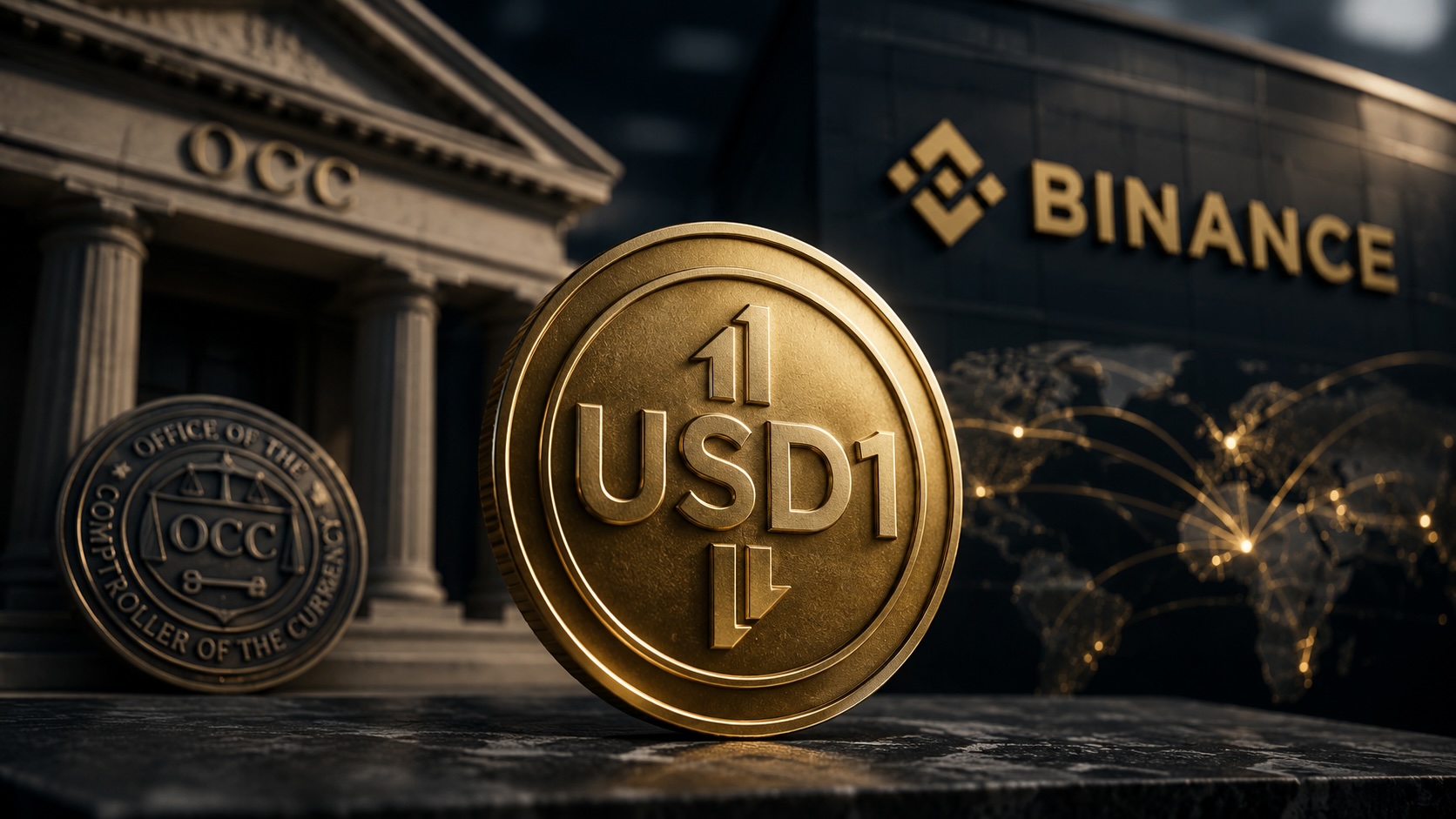
USD1 is issued by World Liberty Financial and custodied by BitGo Trust Company. Reserves are held entirely in US dollar deposits, short-term US Treasuries and government money market funds. Each token is redeemable 1:1 for US dollars through BitGo. The issuer reports monthly attestations from a Big Four accounting firm. World Liberty Trust Company filed a de novo national trust bank charter application with the OCC in January 2026; if approved, the trust would replace BitGo as custodian and move issuance and redemption into federal bank infrastructure. OCC review timelines for such applications typically range from six to 18 months.
Binance expanded USD1 access beyond spot pairs and a prior conversion of Binance-Peg BUSD collateral. Since May 2026, parts of Binance’s futures market have used USD1 as a settlement asset, placing the stablecoin across spot, margin, lending and derivatives on the exchange. Retail trading remains available on Binance, OKX and KuCoin and through Uniswap and PancakeSwap liquidity pools. Primary minting and redemptions are restricted to verified institutional counterparties wiring dollars to BitGo’s reserve accounts. BitGo Mint, launched in April 2026, enables institutions to mint, redeem and manage USD1 within regulated custody.
On-chain distribution in Q2 2026 spanned eight to ten networks. Ethereum held about 41% of supply (roughly $1.99 billion), BNB Chain about 37% (roughly $1.80 billion) and Solana about 21% (roughly $1.02 billion). Smaller allocations were on Aptos, Tron, Plume, Monad, Abcore and Tempo. In May 2026 USD1 launched a native TIP-20 token on Tempo, a Stripe-backed payments-focused chain.
USD1 represented about 1.5% of the $322 billion stablecoin market at quarter-end, ranking fourth among dollar-pegged stablecoins behind USDT, USDC and Sky’s USDS. With roughly $4.8 billion in supply and short-term Treasury yields near 4%, estimated annualized float revenue before operating costs approaches $192 million. World Liberty Financial is estimated to capture between $60 million and $80 million annually from reserve yield on institutional holdings that are not redeemed. Custody fees flow to BitGo.
World Liberty Financial approved governance changes requiring a 180-day WLFI staking lock-up before holders can vote. Node status requires 10 million WLFI staked and grants access to OTC USD1 conversion channels at subsidized rates; Super Node status requires 50 million WLFI and grants guaranteed team access for partnership discussions and additional incentives. Governance participants receive about 2% annual WLFI funded by the protocol treasury.
Regulatory and oversight actions are active. Senators requested records related to a $2 billion Q1 settlement involving USD1, and a House inquiry sought ownership and governance documents tied to a disclosed $500 million UAE stake in World Liberty Financial. USD1’s reserve composition meets GENIUS Act standards. The token does not have MiCA authorization for regulated EU exchanges.
Tags
Articles by this author